UPDATE: 2025 Practitioner Researcher Partnership and Nadia Verrall Grants

We are delighted to announce the successful applicants of the 2025 Practitioner Researcher Partnership and Nadia Verrall Grants.


2025 Practitioner-Researcher Partnership Grants

A hybrid implementation-effectiveness pilot study of communication partner training for healthcare workers in a rehabilitation setting.

Project Leads: Elysha Burgin and Brooke Ryan

Project Summary: This research project examines how Communication Partner Training  (CPT) can be adapted and implemented for a broad range of healthcare workers in a stroke rehabilitation setting to better support people with aphasia. CPT is an evidence based approach that improves communication and healthcare outcomes for people with aphasia but is not always widely used in Australian hospitals. Importantly, the project includes not only clinical staff but also support roles such as catering staff, volunteers, and other workers who regularly interact with patients with aphasia. The study uses a two-phase design. In Phase 1, key stakeholders will codesign a program so that it meets the training needs of busy healthcare workers. In Phase 2, a six-month pilot study will evaluate feasibility, acceptability, and early effectiveness through measures of communication skills, knowledge, and confidence. The project aims to increase training rates, improve experiences for people with aphasia, and support more equitable person-centred rehabilitation. 

The project team includes Brooke Ryan, Elysha Burgin, Emily Brogan, Kirstine Shrubsole, David Harrison, Monique Bertolini, Brooke Rendell-Anderson.

Emergent Literacy Assessment of Autistic Students with Complex Communication Needs: A Professional Learning Package for Speech Pathologists and Teachers
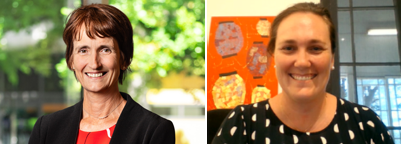
(L-R) Rachael Bowen and Marleen Westerveld

Project Leads: Rachael Bowen and Marleen Westerveld

Project Summary: This project will create a free, online professional learning package to help speech pathologists and teachers assess emergent literacy skills in school‑age autistic students with complex communication needs, many of whom have an intellectual disability. The work builds on an established partnership between clinicians, educators, and researchers, and aims to make a successful school‑based approach available to a wider autism community.

Through partnership with key stakeholders, the learning package will be co‑designed to ensure it is practical, relevant, and easy to use. We will evaluate whether the content is meaningful and useful, identify areas for improvement, and examine whether completing the package increases participants’ knowledge and confidence in emergent literacy assessment.

The key outcome will be an evidence‑based, socially valid online resource that supports early, targeted, and individualised literacy intervention for a highly vulnerable group of students. This project aligns strongly with Speech Pathology Australia’s priorities of equitable access to services and building a connected professional community.

This project is led by Marleen Westerveld (Griffith University) and Rachael Bowen (Giant Steps Australia), in collaboration with Katherine Halter (Giant Steps), Sally Clendon (Massey University, NZ), Jessica Paynter (Griffith University), and Kaitlin Hunter (Giant Steps).


2025 Nadia Verrall Grant

Conversations: Understanding the lived experiences of children and young people who are hard of hearing.

Jenna Bongioletti

Project Lead: Jenna Bongioletti

Project Summary: Advances in diagnostic testing, technology and early intervention mean that many children born with a permanent hearing difference can learn to listen and speak at similar levels to their peers. However, there doesn’t seem to be a clear relationship between spoken language skills and success in everyday conversations. This study asks an important question: if spoken language alone is not enough, what else helps conversations go well? Jenna and her collaborators will interview children and young adults who are hard of hearing to learn about their everyday conversation experiences, including what they find easy, what they find challenging, and what helps them succeed. The team will use qualitative research methods to look for common themes in the interviews. The goal is to better understand the ingredients of successful and enjoyable conversations so that future support can be designed around the real experiences of children and young people who are hard of hearing.